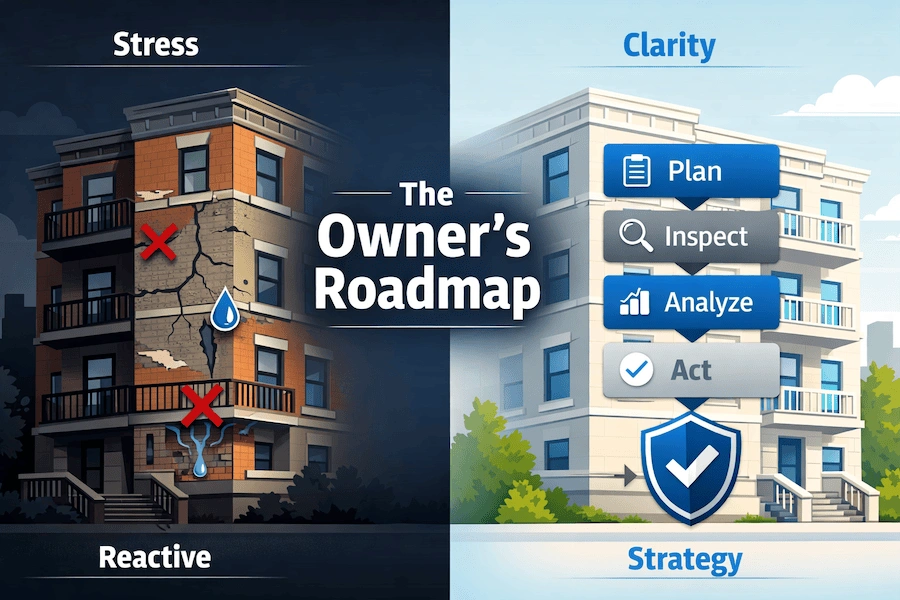
If you manage a building in Quebec with five storeys or more, you’re already aware of the mandatory building facade inspection requirement (Bill 122). For many, this feels like a bureaucratic box to tick—a costly obligation with a looming deadline.
But what if we told you this inspection could be one of the most valuable strategic tools for your long-term capital planning and financial health?
As structural engineers who conduct these inspections across Montreal, we see the difference between owners who simply comply and those who leverage the process. This guide is for building owners and managers who want to transform an obligation into an opportunity.
The Inspection, Decoded: What Really Happens?
Beyond simply "looking at the outside," a proper Facade inspection is a forensic analysis. For your building, we will:
Conduct a hands-on, close-up visual assessment of the entire Facade: cladding (brick, stone, EIFS, precast), windows, sealants, balconies, parapets, and roof interfaces.Document every deficiency with high-resolution photography and precise location mapping.Investigate the causes, not just the symptoms. Is the sealant failure due to poor installation, or is there underlying movement causing stress?Assess water management systems (flashings, weep holes, drainage planes) that are invisible from the ground.Provide a risk-based prioritization of repairs based on severity, water intrusion potential, and impact on durability.From Compliance to Capital Strategy: The Mindset Shift
The mandatory report you receive shouldn’t just be filed away. It should become the foundation of your 5 to 10-Year Facade Maintenance and Repair Plan. Here’s how:
Prioritize with Confidence, Not Panic: The report categorizes issues as Critical, Major, or Minor. This lets you move beyond the "loudest leak" method of budgeting. You can allocate funds first to problems that protect the asset's integrity and resident safety.Budget Accurately and Avoid Surprises: A detailed engineering report provides credible scopes of work. You can use this to get realistic tenders from contractors and present well-founded budgets to your board or ownership group. No more guesswork.Sequence Repairs Intelligently: Does it make sense to patch sealants now if the entire cladding will be replaced in 5 years? The inspection report provides the data to sequence interrelated repairs for maximum cost-efficiency.Establish a Baseline for Future Inspections: This first report is your benchmark. The next inspection (due in 5 years) will clearly show what has deteriorated, what repairs were effective, and what new issues have emerged, proving the value of your maintenance program.The Montreal-Specific Pitfalls We Uncover
Our climate is uniquely punishing. In our inspections, we consistently find:
Balcony & Terrace Failures: Waterproof membrane breaches, poor slope leading to ponding, and concrete spalling exposing rebar—a major liability.Parapet & Roof Edge Degradation: Often overlooked, these are critical transition zones where most water infiltration originates.Masonry Deterioration: The relentless freeze-thaw cycle spalls brick and stone, especially on the building’s north and east elevations.Sealant Fatigue: Montreal’s temperature extremes cause sealants at window perimeters and control joints to fail prematurely, becoming direct water entry points.The High Cost of a "Minimalist" Inspection
Choosing an inspector based on lowest fee can be disastrous. A superficial inspection might miss:
Concealed damage behind cladding.Systemic design flaws causing repetitive failures.The true urgency of a deficiency, leading to delayed action and exponentially higher repair costs after water damage occurs.You need an inspector who thinks like an engineer and a long-term partner, not just a checklist auditor.
For a 12-unit condominium in the Plateau, a Facade inspection revealed that localized brick spalling was a symptom of a failed roof drainage system cascading water down the facade. Addressing just the bricks would have been a recurring cost. The report prioritized rebuilding the roof parapet and drainage, solving the root cause and protecting the entire investment.
Your Action Plan as a Building Steward
Start Early. Don’t wait for the deadline. Engage an engineering firm 6-8 months in advance to allow time for a thorough inspection, report preparation, and initial planning.Demand Engineering Rigor. Ensure your chosen provider is a licensed engineering firm with specific Facade expertise, not just a generalist.Plan for Access. Budget for and coordinate swing stages or scaffolding—a proper inspection cannot be done adequately from the ground or with binoculars.Use the Report as a Living Document. Integrate its findings into your reserve fund study and annual board meetings.Turn a regulatory requirement into your most powerful planning tool.
Our building Facade inspections are conducted with the rigor of forensic engineers and the perspective of asset managers. We deliver more than a compliance report; we deliver a clear, actionable roadmap for preserving your building’s value and ensuring its longevity for decades to come.
Facing an upcoming inspection deadline or have concerns about your facade? Let's discuss a strategic approach.