← BACK TO BLOG
    BUILDINGS2026-01-105 min read

    The Hidden Structure: Why Your Underground Parking Garage Demands Proactive Inspections

    Proactive structural inspections are not an expense; they are vital asset preservation.
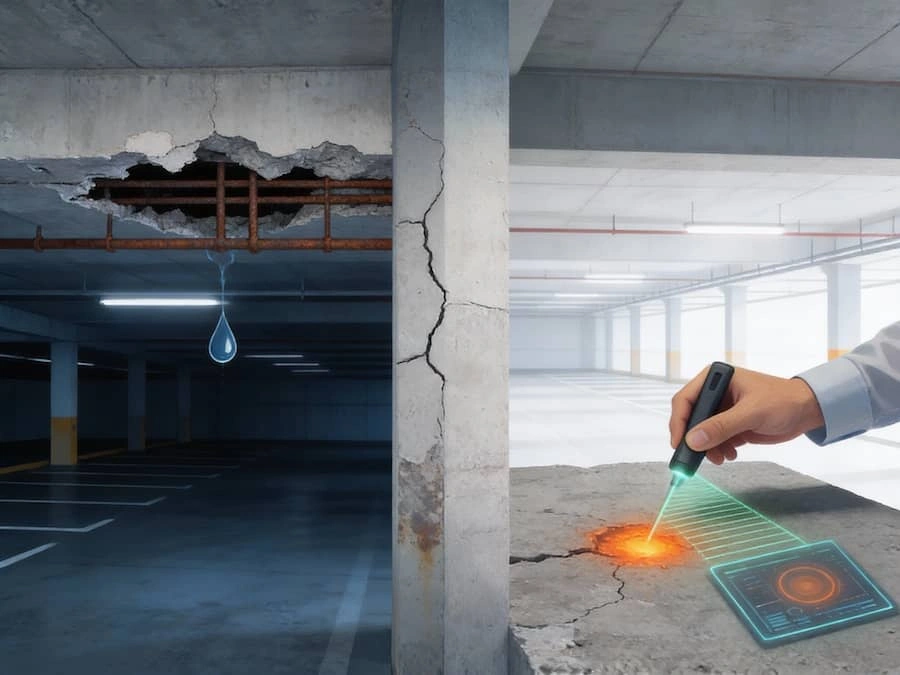
    The Hidden Structure: Why Your Underground Parking Garage Demands Proactive Inspections

    For many building owners and managers, the underground parking garage is "out of sight, out of mind"—a utilitarian space that generates revenue but doesn't demand much attention until a crisis occurs. This is a dangerous and costly misconception.

    Your underground garage is the structural foundation of your entire building. Its columns, walls, and slabs are under constant, immense load. In Montreal’s environment, they are also under relentless chemical and physical attack.

    Waiting for a piece of concrete to fall or a major leak to appear is a strategy of negligence that risks safety, triggers massive special assessments, and devastates property values. Proactive structural inspections are not an expense; they are vital asset preservation.


    The Silent Enemies of Your Parking Structure

    Three primary forces are degrading your garage right now:

    Chloride-Induced Corrosion (The #1 Killer):

  1. Source: Road salt (chlorides) tracked in by vehicles during our long winters.
  2. Process: Chlorides penetrate the concrete, reaching the steel rebar. They break down the protective layer, causing the rebar to rust.
  3. Result: Rust occupies more volume than steel, creating immense internal pressure. This causes the concrete to spall (crack and delaminate), exposing more rebar and accelerating the cycle. Structural capacity is compromised.
  4. Freeze-Thaw Damage:

    Water seeps into concrete pores. It freezes, expands, and creates micro-cracks. Over hundreds of cycles, these cracks connect, leading to surface scaling and loss of concrete cover over the rebar.

    Chronic Water Infiltration:

    Leaks from faulty waterproofing or cracks lead to constant dampness, accelerating corrosion, promoting mold, and damaging electrical systems and vehicles.


    What a Proactive Structural Inspection Uncovers

    Our inspections go far beyond a casual walk-through. We conduct a systematic, forensic evaluation:

  5. Mapping & Delamination Survey: We systematically sound the concrete (hammer or chain-drag) to detect hollow, delaminated areas where the surface is about to spall off.
  6. Crack Mapping & Analysis: We document every crack, measuring its width, length, and pattern to determine if it’s superficial shrinkage or indicative of structural movement or overload.
  7. Spalling & Rebar Exposure Assessment: We quantify the extent of damage, the percentage of rebar section lost to corrosion, and the immediate risk of falling debris.
  8. Chloride Ion Penetration Testing: We may take dust samples to measure the chloride content at the depth of the rebar, predicting future corrosion activity.
  9. Load-Path & Column Assessment: We check for column distress, excessive deflection in slabs or beams, and the condition of connections.
  10. Drainage & Waterproofing Review: We identify the sources of water ingress and evaluate the functionality of drains and sumps.

  11. The Consequences of Deferred Maintenance: A Montreal Case Study

    A 40-unit condominium in Ville-Marie deferred garage inspections for over a decade due to budget constraints. When they finally did it, they found:

  12. Over 60% of ceiling slabs had active delamination.
  13. Critical column capitals had severe spalling, with an estimated 30% loss of rebar cross-section.
  14. Chloride levels were 4x the corrosion threshold.
  15. The required repair—including demolition, concrete removal, cathodic protection, and rebuilding—exceeded $1.2 million. A proactive inspection and targeted repair program 10 years earlier could have limited the cost to under $200,000 and avoided the emergency closure and resident turmoil.


    Your Proactive Management Plan

  16. Baseline Inspection: If you’ve never had one, schedule a comprehensive inspection immediately to establish the current condition.
  17. Regular Monitoring: Implement a 3-5 year inspection cycle. Corrosion doesn't sleep.
  18. Prioritized Repair Program: Use the inspection report to execute a phased repair plan, addressing safety-critical spalls and leaks first, followed by corrosion mitigation.
  19. Preventative Measures: Implement a rigorous salt/wash-down protocol in winter, improve ventilation to reduce humidity, and ensure all leaks are addressed promptly.

  20. The Engineer’s Role: Guardian of the Asset

    A contractor will give you a price to fix what they see. An engineer provides:

  21. An unbiased condition assessment with no vested interest in the repair contract.
  22. A diagnosis of the root cause (e.g., is the leak from a failed joint or a structural crack?).
  23. Engineered repair specifications that ensure the fix is durable, code-compliant, and addresses the systemic issue.
  24. Surveillance during repair work to ensure specifications are followed—a critical service for complex concrete restoration.

  25. Your parking garage is the bedrock of your building’s value and safety. Don’t wait for a failure to reveal its secrets.

    Our underground parking inspections provide the technical clarity you need to make informed, strategic decisions. We identify risks before they become emergencies and provide engineered solutions to extend the service life of your most critical structural asset.
    We use cookies to enhance your browsing experience and analyze site traffic. By clicking "Accept", you consent to our use of cookies. Privacy Policy